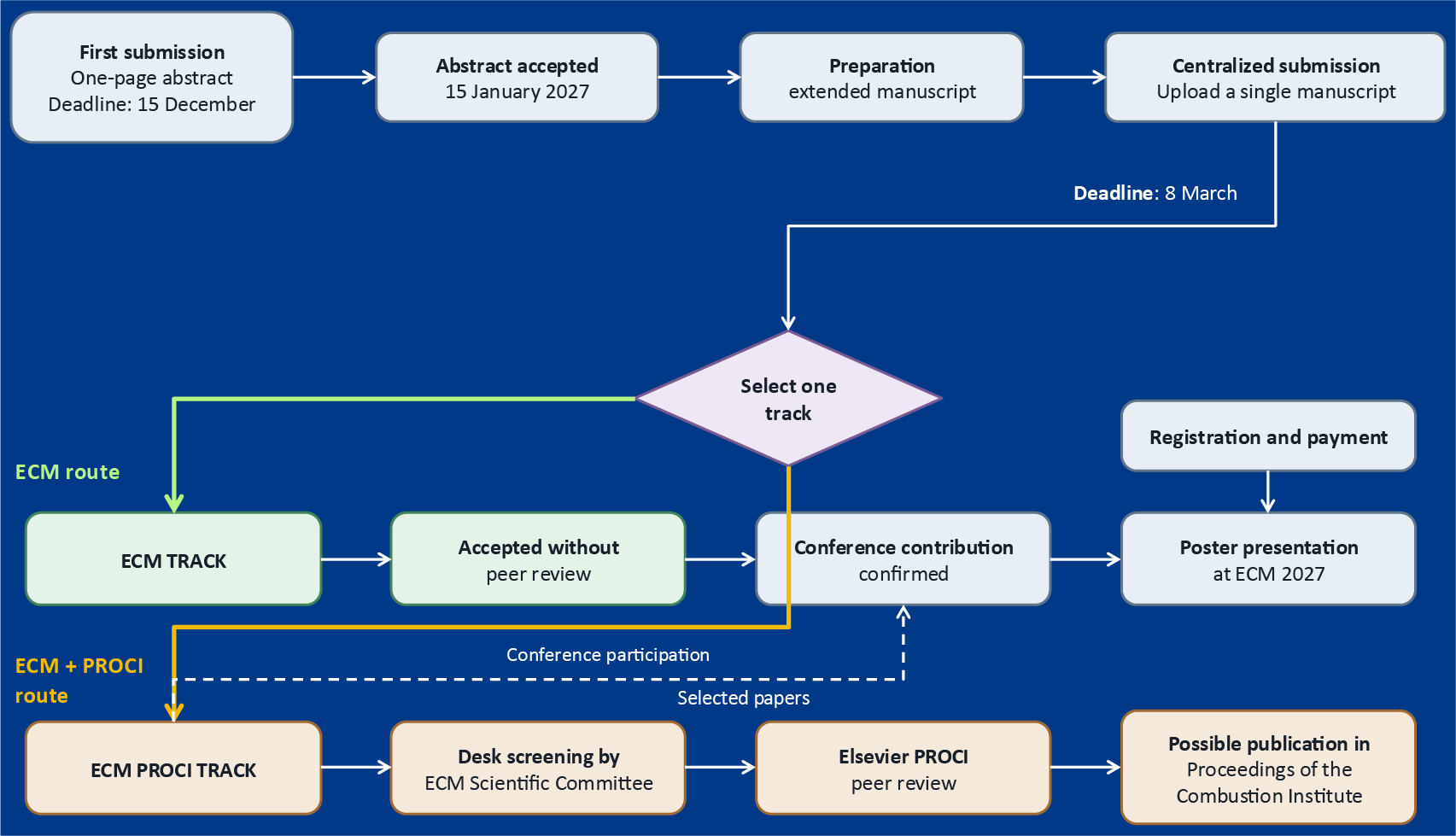
ECM 2027 is organised around five invited plenary lectures along with a poster presentation format with five sessions. Authors who wish to present a poster must first submit a one-page abstract. After the abstract has been accepted, the authors should prepare an extended manuscript and upload it through the central ECM 2027 full-manuscript submission system.
Authors first submit a one-page abstract. After acceptance, they make one centralised full-manuscript submission and select one track within that submission. Within this single submission, authors can select either the ECM Track or the ECM PROCI Track. The track choice determines the applicable deadline and review process, it does not require a second manuscript upload.
The ECM Track follows the standard conference route and is included in the ECM proceedings without additional review. The ECM PROCI Track is intended for authors who want their manuscript to be considered for publication in the Proceedings of the Combustion Institute. It includes desk screening followed, for selected papers, by the Elsevier PROCI review process. Authors who select the ECM PROCI Track must participate in ECM 2027. The submission workflow is summarised in Figure 1.
Prepare and submit a one-page abstract in PDF format using the ECM 2027 Word or LaTeX abstract template.
Select the conference topic that best matches the work.
After acceptance of the abstract, prepare one extended manuscript through the central ECM 2027 full-manuscript submission system and select either the ECM Track (using the given template) or the ECM PROCI Track (using PROCI template). Submit it by the deadline for the selected track; the two deadlines may differ.
Complete registration and payment, which can be done after the submission. Each poster must be linked to a valid paid registration before it can be included in the final programme and displayed at the conference.
Content:state the purpose of the work, the approach, the principal results, and the main conclusion clearly enough for the scientific committee to assess its relevance.
Language: English.
Presentation format: accepted contributions are presented as posters.
Full manuscript tracks
A full manuscript is required for every accepted poster. Authors upload one extended manuscript through the central submission system and select one of the following tracks within that submission.
Route
Purpose and review
Availability and publication
Full manuscript format
ECM Track
Standard conference route. The manuscript is accepted without peer review and supports scientific discussion around the poster.
The manuscript will be made available to registered conference participants. It will not be published as a journal article.
Full manuscript with a maximum length of 10 pages.
ECM PROCI Track
Publication route for authors who want their manuscript to be considered for a special issue of the Proceedings of the Combustion Institute. The ECM Scientific Committee first conducts desk screening. Manuscripts that pass this stage enter the Elsevier PROCI review process.
Only manuscripts that complete the journal review and acceptance process will be published by the Proceedings of the Combustion Institute. Authors selecting this track must participate in ECM 2027.
Full manuscript with a maximum length of 6 pages + references following the PROCI format
Poster requirements
Each accepted poster will be assigned to a poster session and room. The presenting author must:
place the poster in the assigned location before the session begins;
remain with the poster during the assigned session; and
remove and collect the poster at the end of the session.
Posters must be A0 size in portrait orientation. There is no mandatory poster template. Authors may use their own design. ECM 2027 will not provide a poster-printing service, so presenters must bring a printed poster to the conference.
Conference topics
Low Emission Combustion Technologies. Low-carbon and hydrogen-based fuels, MILD combustion, oxy-fuel combustion, chemical looping, NOx and SOx reduction, and carbon-capture strategies.
Gas Phase Reaction Kinetics. Kinetics of hydrocarbons and oxygenated fuels, formation of gaseous pollutants, elementary reactions, and mechanism generation and reduction.
Diagnostics. Development and application of diagnostic techniques and sensors for understanding and controlling combustion and reacting-flow phenomena.
Laminar Flames. Experiments, theory, and modelling of ignition, structure, propagation, extinction, stabilisation, dynamics, and instabilities.
Turbulent Flames. Experiments, theory, and modelling of ignition, structure, propagation, extinction, stabilisation, dynamics, and instabilities.
Spray Droplet and Supercritical Combustion. Atomisation and combustion of droplets, sprays, and supercritical fluids.
Detonation Explosion and Supersonic Combustion. Flame acceleration, deflagration-to-detonation transition, rotating- and pulse-detonation engines, constant-volume combustion engines, and scramjet engines.
Solid Fuel Combustion. Pyrolysis, oxidation, gasification, and ash formation from coal, biomass, and waste, together with combustion of propellants and metals.
Fire Research. Ignition, burning, fire spread and suppression, and applications to building, urban, and wildland fire safety.
Propulsion. Device-specific aspects of fuels, emissions, injection, stability, and combustion dynamics in reciprocating engines, gas turbines, and rocket engines.
Soot Nanomaterials and Large Molecules. Formation, growth, and destruction of soot, polycyclic aromatic hydrocarbons, carbon nanostructures, and other nanoscale materials.
Numerical Combustion. Discretisation and meshing, high-order methods, high-performance computing, machine learning, uncertainty quantification, experimental design, and generation of numerical data.
Multi Physics Phenomena. Plasma-, electric-, and magnetic-field-assisted combustion, catalysis, coupled heat transfer, microchannel reactors, fuel cells, fuel synthesis and transformation, and electrolysis.